Stimulants
Step 1: What the Drug Does
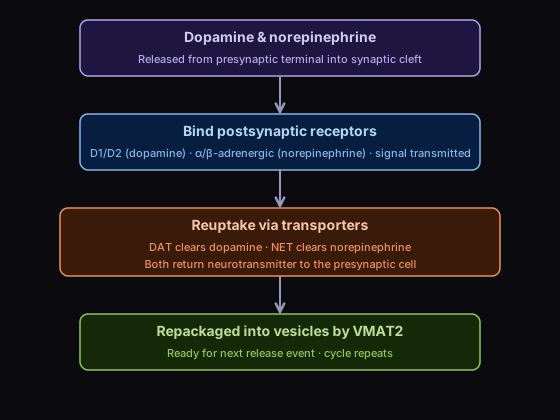
Normal synapse - dopamine and norepinephrine are released, do their job, then get vacuumed back up by transporters (DAT for dopamine, NET for norepinephrine):
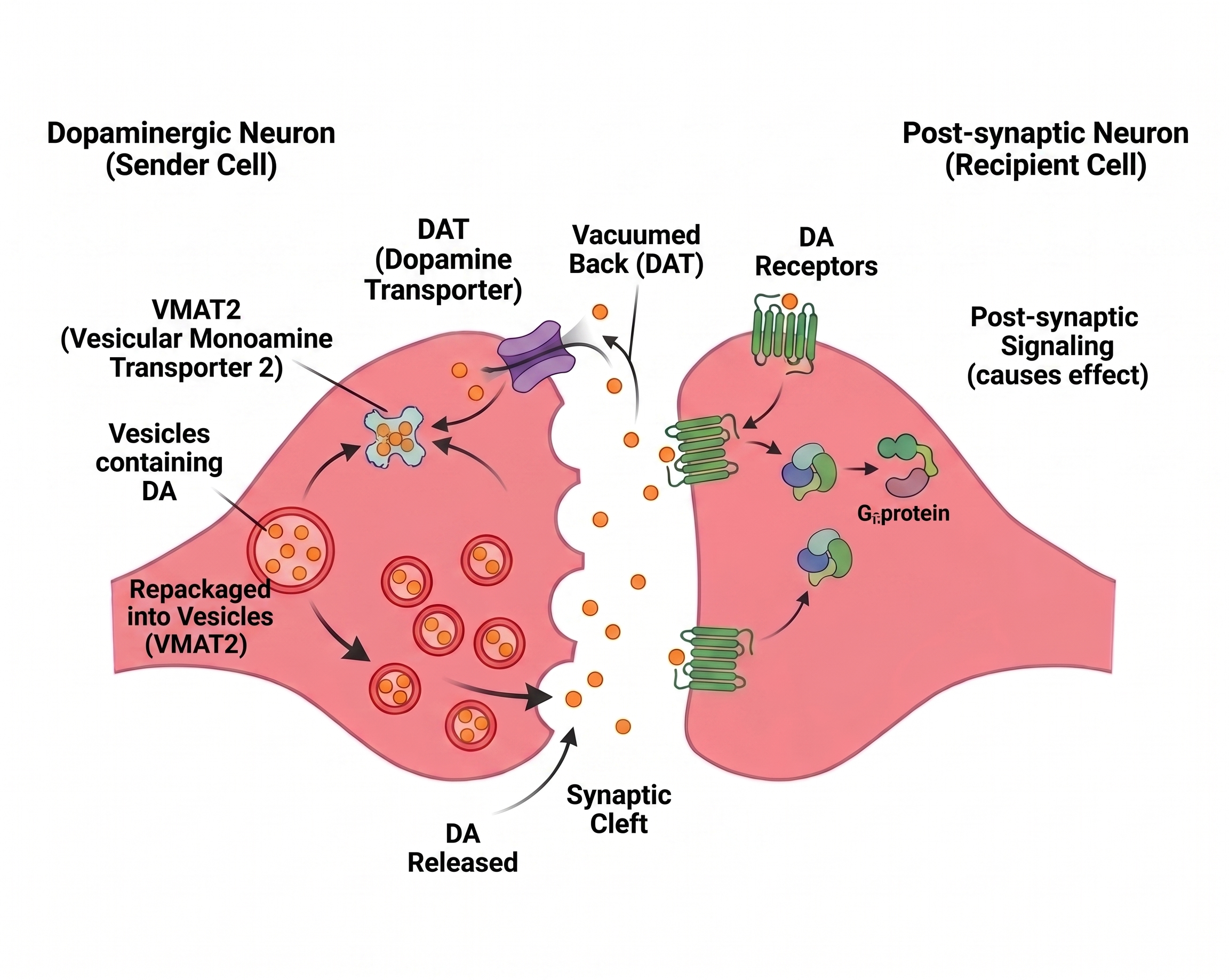
Video: Dopamine Synapse (in depth) - click to expand ↗ YouTube
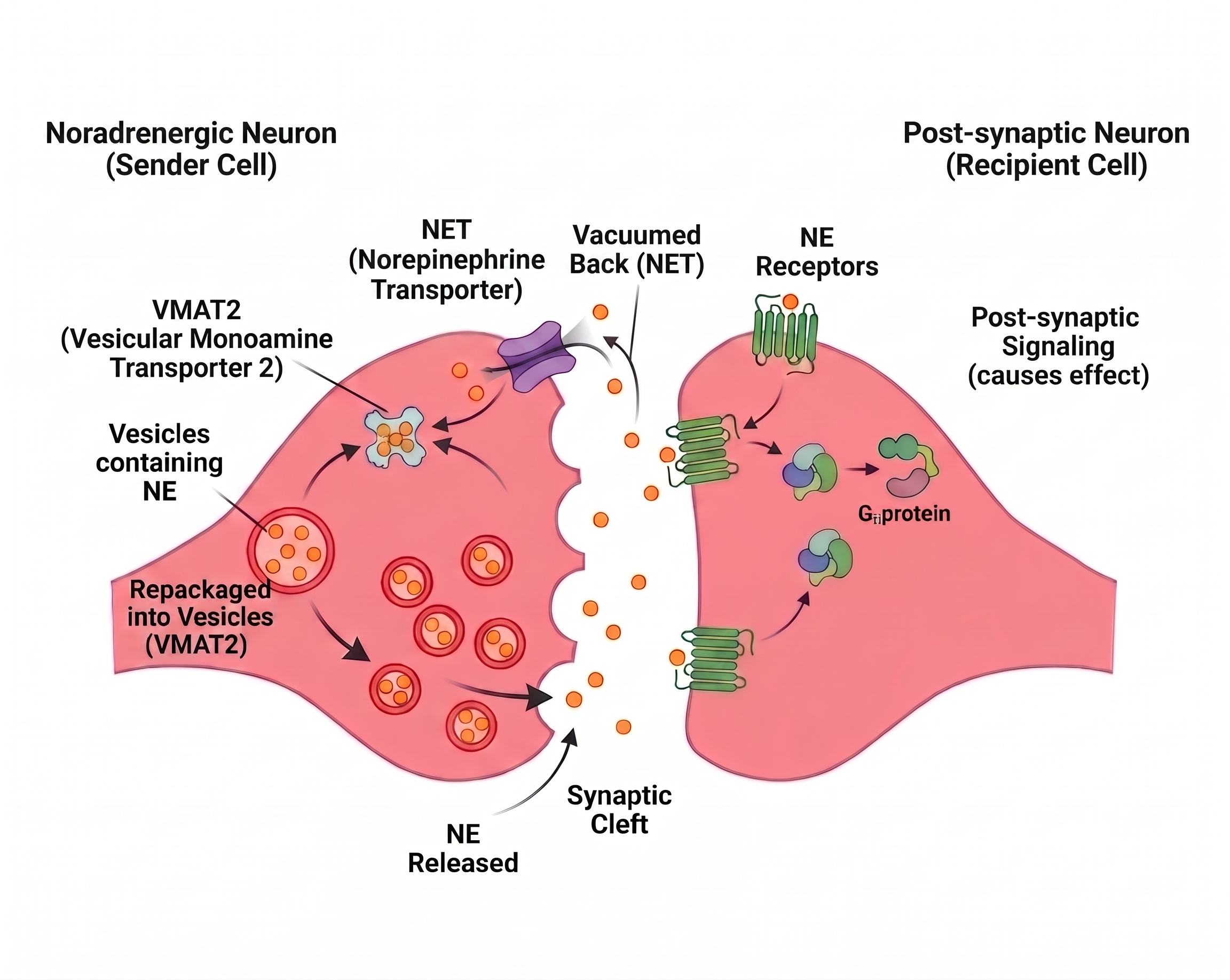
Video: Norepinephrine Synapse (in depth) - click to expand ↗ YouTube
Stimulants act on this cleanup system in two distinct ways:
Cocaine and methylphenidate - pure blockade
Physically plug DAT and NET. Dopamine that gets released has nowhere to go. Piles up in the cleft. ↑ dopamine in synapse, ↑ NE in synapse (Freyberg et al., 2016).
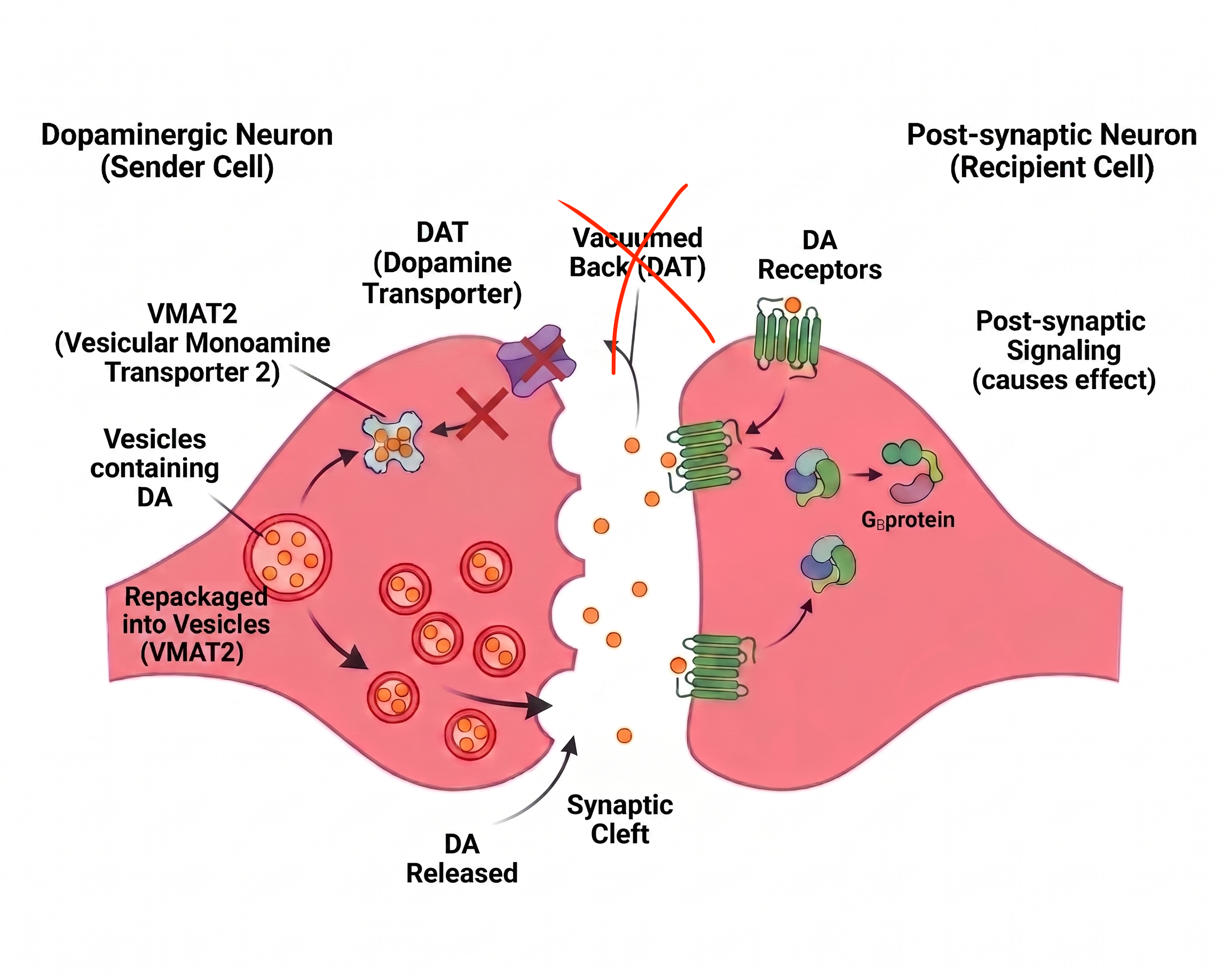
Video: Methylphenidate (Ritalin) - click to expand ↗ YouTube
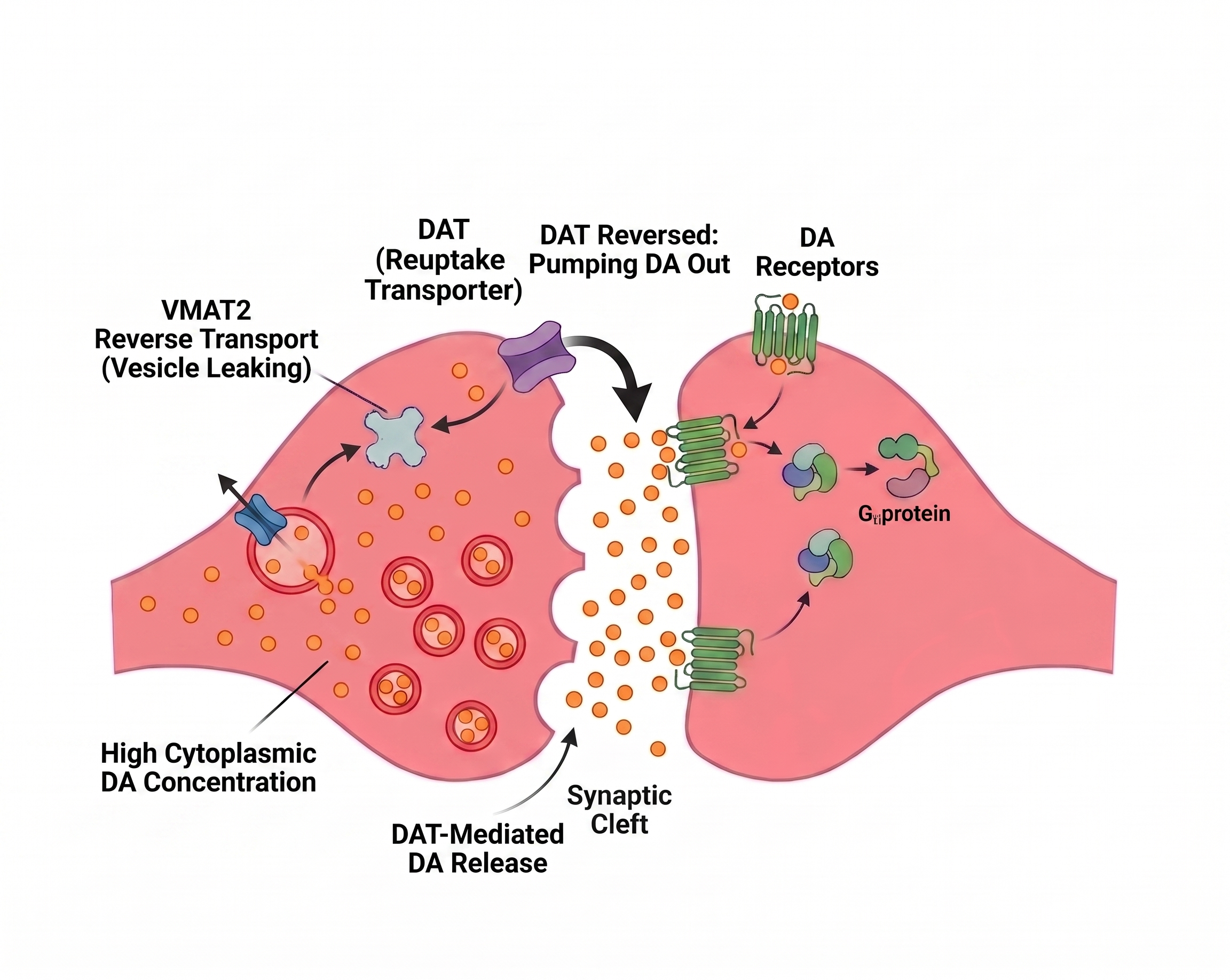
Amphetamines - full reversal
Substrates of DAT (pumped into the cell) and VMAT2 (vesicular monoamine transporter 2, pumped into vesicles). Inside vesicles, amphetamines disrupt the proton gradient → dopamine leaks out into the cytoplasm. Cytoplasmic dopamine gets so high that DAT runs backwards and pumps dopamine out into the synapse. The cleanup tool becomes a release tool (Sulzer et al., 2005). ↑ cytoplasmic dopamine, ↓ vesicular dopamine, DAT runs ↑ in reverse.
Video: Amphetamine - click to expand ↗ YouTube
One-line summary: Stimulants = "more dopamine and norepinephrine in the gap, way longer than normal."
Step 2: What Dopamine and Norepinephrine Normally Do
- Dopamine - signals "this was worth doing, do it again." Released in small, controlled bursts during natural rewards (food, sex, accomplishment).
- Norepinephrine - signals "wake up, focus, this matters." Drives arousal, alertness, the fight-or-flight response.
Both systems are tightly regulated because they're expensive to run and dangerous when constant.
Step 3: Where DAT/NET Live
DAT and NET are concentrated in five regions. Each region's normal job is what gets altered.





Step 4: How Side Effects Fall Out
Each side effect = excess dopamine or norepinephrine in a specific region altering that region's normal job.
Euphoria, Focus, Energy
Elevated dopamine in NAc reinforces the behavior strongly. PFC dopamine ↑ sharpens focus (basis of ADHD treatment). Elevated NE in locus coeruleus drives the wired feeling.
↑
Cardiovascular Stress - what kills people
Excess norepinephrine binds:
α1 receptors on blood vessel smooth muscle → ↑ vasoconstriction → ↑ blood pressure.
β1 receptors on the heart's pacemaker → ↑ tachycardia.
Heart pumping fast against a high-resistance circuit for hours → risk of MI, stroke, aortic dissection. Even in young, healthy users.
Can be mitigated by beta-blockers (e.g. propranolol, which blocks β1/β2) or α2 agonists (e.g. clonidine, which reduces central sympathetic outflow - note: clonidine is not an α-blocker).
↑
Hyperthermia
Hypothalamus normally adjusts core temp via skin vasodilation and sweating. Stimulants disrupt the set point AND vasoconstrict skin vessels → heat can't escape → ↑ core body temp. Fatal at sustained core body temperature of 41–42°C.
.png) ↑
↑
Stereotyped Repetitive Movements (high doses)
Basal ganglia normally smooths motor sequences. Excess dopamine ↑ drives hyperactivation of motor loops → tics, jaw clenching, repetitive behaviors ("tweaking").
↑
Appetite Suppression
Hypothalamus hunger circuits suppressed by ↑ dopamine signaling → ↓ hunger.
↓
The Balancing Loop
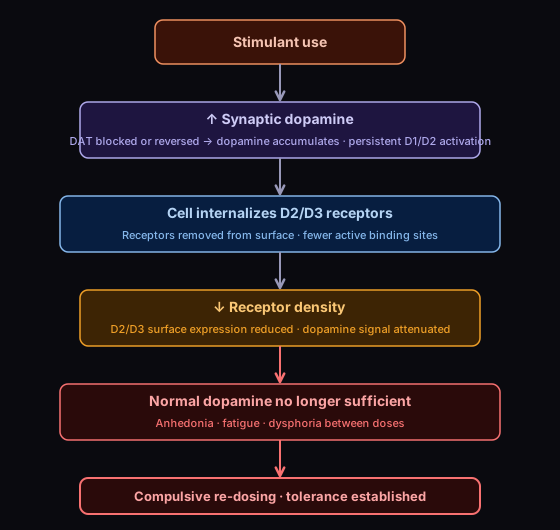
The brain adapts to artificial overstimulation by ↓ downregulating dopamine receptors - deleting D2 receptors to compensate for the flood (Trifilieff & Martinez, 2014; Volkow et al., 2009). Normal life starts feeling empty because the reward signal now requires drug-level dopamine just to register. This drives compulsive re-dosing.
User Manual
User Manual: Hydrate, stay cool - but do not overdrink plain water. Hyponatremia (dilutional low sodium) has been reported with high-dose stimulant use, especially at events with intense physical exertion. Sip, don't chug; include electrolytes. Cardiac risk is dose- and frequency-dependent - stacking doses ("re-dosing on the come-up") multiplies it. Chest pain, severe headache, vision changes, or confusion are signs of stroke or heart attack. Get medical help immediately.
Sources
- Freyberg, Z., et al. (2016). Mechanisms of amphetamine action illuminated through optical monitoring of dopamine synaptic vesicles in Drosophila brain. Nature Communications, 7, 10652. https://doi.org/10.1038/ncomms10652
- Neuroscientifically Challenged. (n.d.). 2-Minute neuroscience: Amphetamine [Video]. YouTube. https://www.youtube.com/watch?v=5fYetx-UNEI
- Neuroscientifically Challenged. (n.d.). 2-Minute neuroscience: Dopamine [Video]. YouTube. https://www.youtube.com/watch?v=Wa8_nLwQIpg&t=9s
- Neuroscientifically Challenged. (n.d.). 2-Minute neuroscience: Methylphenidate [Video]. YouTube. https://www.youtube.com/watch?v=JTQQkC23hyY
- Neuroscientifically Challenged. (n.d.). 2-Minute neuroscience: Norepinephrine [Video]. YouTube. https://www.youtube.com/watch?v=m8kthApqQys
- Sulzer, D., et al. (2005). Mechanisms of neurotransmitter release by amphetamines: a review. Progress in Neurobiology, 75(6), 406–433. https://doi.org/10.1016/j.pneurobio.2005.04.003
- Trifilieff, P., & Martinez, D. (2014). Imaging addiction: D2 receptors and dopamine signaling in the striatum as biomarkers for impulsivity. Neuropharmacology, 76(Pt B), 498–509. https://doi.org/10.1016/j.neuropharm.2013.06.031
- Volkow, N. D., et al. (2009). Imaging dopamine's role in drug abuse and addiction. Neuropharmacology, 56(Suppl 1), 3–8. https://doi.org/10.1016/j.neuropharm.2008.05.022