Drug Synthesis & Impurities
Street drugs are not pure. The synthesis process (done in clandestine labs without pharmaceutical-grade equipment, purification, or quality control) leaves behind a predictable set of byproducts. On top of those, drugs are deliberately "cut" with cheaper substances to stretch profit.
Knowing what's likely in a bag, based on how the drug was made, helps users assess what they're actually consuming. This module covers the synthesis route for each major drug, the predictable impurities that result, the typical adulterants added afterward, and where possible, methods used to remove or detect them.
Note on structure: This module does not follow the Step 1→4 pharmacology template used in Modules 4–7. Each submodule instead covers synthesis route, predictable byproducts, adulterants, and detection methods for a specific drug. The pharmacology of each drug is addressed in the earlier modules.
Numbering: Submodules 10.1–10.4 cover drug impurities. Submodules 10a and 10b cover special topics (orchestral drugs; addiction data). These use different numbering schemes intentionally - they are distinct content types within the same module.
Where impurities cannot be removed, that is stated plainly. People will use these drugs anyway; what follows is information to reduce harm.
Synthesis routes are described only at the level needed to explain where contamination comes from - deliberately not enough detail to make anything.
The General Pattern
Three layers of contamination accumulate from production to consumer:
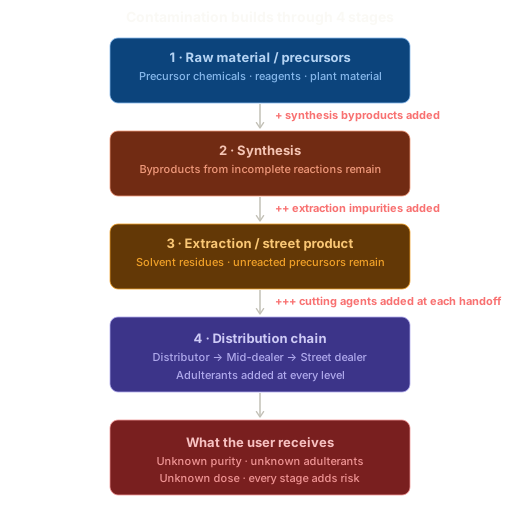
A Note on the Probability Estimates
Each adulterant carries a rough probability: the estimated chance a given street sample contains it. These are estimates, not measurements of your specific bag. They are built from three source types, in descending order of reliability:
- Forensic seizure data (DEA, EMCDDA, national crime labs) - large sample sizes, but most seizures are wholesale (kilo-level bricks), which are consistently purer than what reaches a street-level user. Wholesale data understates street-level cutting.
- Community drug-checking services (DrugsData, Energy Control, DIMS, harm-reduction labs) - closer to street-level reality, but the sample is self-selected; people test drugs they're already suspicious of, which can overstate adulteration.
- Clinical/toxicology literature - case series and user-cohort studies; good for confirming a substance appears, weaker for prevalence.
The honest read: wholesale forensic data is a floor, drug-checking data is closer to street reality, and the truth for any individual sample is unknowable without testing it. Where the estimate is genuinely low, that is stated. Where data sources disagree sharply, that is stated too.
10.5 - General Practical Note on Removal
Adulterants integrated during synthesis cannot be removed without lab-grade chemistry. Bulking agents added at street level can sometimes be partly separated by differential solubility (recrystallization), but this is unreliable, loses active drug, and never approaches pharmaceutical purity.
The useful interventions are pre-use, not post-use:
- Reagent test kits (Marquis, Mecke, Mandelin, Simon's) - confirm identity, ~$30
- Fentanyl test strips - detect fentanyl, ~$1 each
- Mail-in drug-checking services where legal (DrugsData, Energy Control)
- Use less; start below the expected dose; never use alone
User Manual
The supply is more variable than at any point in modern history. Two bags of "the same" drug from "the same dealer" can differ wildly in content. Tolerance built over weeks gives no protection against a sudden change in purity. The probability estimates in this module describe the market; they do not describe your bag. Test what you can, dose low, never alone.
Sources
- Brunt, T. M., et al. (2017). Adulterants in cocaine and ecstasy: prevalence and pharmacology. Drug Testing and Analysis, 9(2), 245–259. https://doi.org/10.1002/dta.1986
- Brzezinski, M. R., et al. (1994). Purification and characterization of a human liver cocaine carboxylesterase. Biochemical Pharmacology, 48(9), 1747–1755. https://doi.org/10.1016/0006-2952(94)90461-8
- Casale, J. F., & Waggoner, R. W. (1991). A chromatographic impurity signature profile analysis for cocaine. Journal of Forensic Sciences, 36(5), 1312–1330. https://doi.org/10.1520/JFS13154J
- Centers for Disease Control and Prevention. (2024). Polysubstance overdose. CDC Overdose Prevention. https://www.cdc.gov/overdose-prevention/about/polysubstance-overdose.html
- Drug Enforcement Administration. (2024). 2024 National Drug Threat Assessment and CY2024 Annual Cocaine Report. https://www.dea.gov/sites/default/files/2024-05/NDTA_2024.pdf
- Hofmaier, T., et al. (2018). Cognitive and neuroanatomical impairments associated with chronic exposure to levamisole-contaminated cocaine. Translational Psychiatry, 8, 235. https://doi.org/10.1038/s41398-018-0279-3
- Krotulski, A. J., et al. (2025). Characterizing rapid changes in the prevalence and concentration of key compounds in Philadelphia's street opioid retail supply, March 2024–March 2025. Drug and Alcohol Dependence, 270, 112627. https://doi.org/10.1016/j.drugalcdep.2025.112627
- Lambdin, B. H., et al. (2023). Prevalence of fentanyl in methamphetamine and cocaine samples collected by community-based drug checking services. Drug and Alcohol Dependence, 252, 110955. https://doi.org/10.1016/j.drugalcdep.2023.110955
- Larocque, A., & Hoffman, R. S. (2012). Levamisole in cocaine: unexpected news from an old acquaintance. Clinical Toxicology, 50(4), 231–241. https://doi.org/10.3109/15563650.2012.665455
- Palamar, J. J., et al. (2024). Misrepresentation of MDMA in the United States, 1999–2023. Drug and Alcohol Dependence, 264, 112432. https://doi.org/10.1016/j.drugalcdep.2024.112432
- Skinner, H. F. (1990). Methamphetamine synthesis via hydriodic acid/red phosphorus reduction of ephedrine. Forensic Science International, 48(2), 123–134. https://doi.org/10.1016/0379-0738(90)90104-7
- Solimini, R., et al. (2017). Cocaine adulteration: Worldwide review. Frontiers in Public Health, 5, 130. https://doi.org/10.3389/fpubh.2017.00130
- Tallarida, C. S., et al. (2014). Levamisole and cocaine synergism: a prevalent adulterant enhances cocaine's action in vivo. Neuropharmacology, 79, 590–595. https://doi.org/10.1016/j.neuropharm.2014.01.002
- Windahl, K. L., et al. (1995). Investigation of the impurities found in methamphetamine synthesised from pseudoephedrine by reduction with hydriodic acid and red phosphorus. Forensic Science International, 76(2), 97–114. https://doi.org/10.1016/0379-0738(95)01803-4
- EcstasyData/DanceSafe. (2010–2024). EcstasyData lab testing results database. DanceSafe. https://www.ecstasydata.org